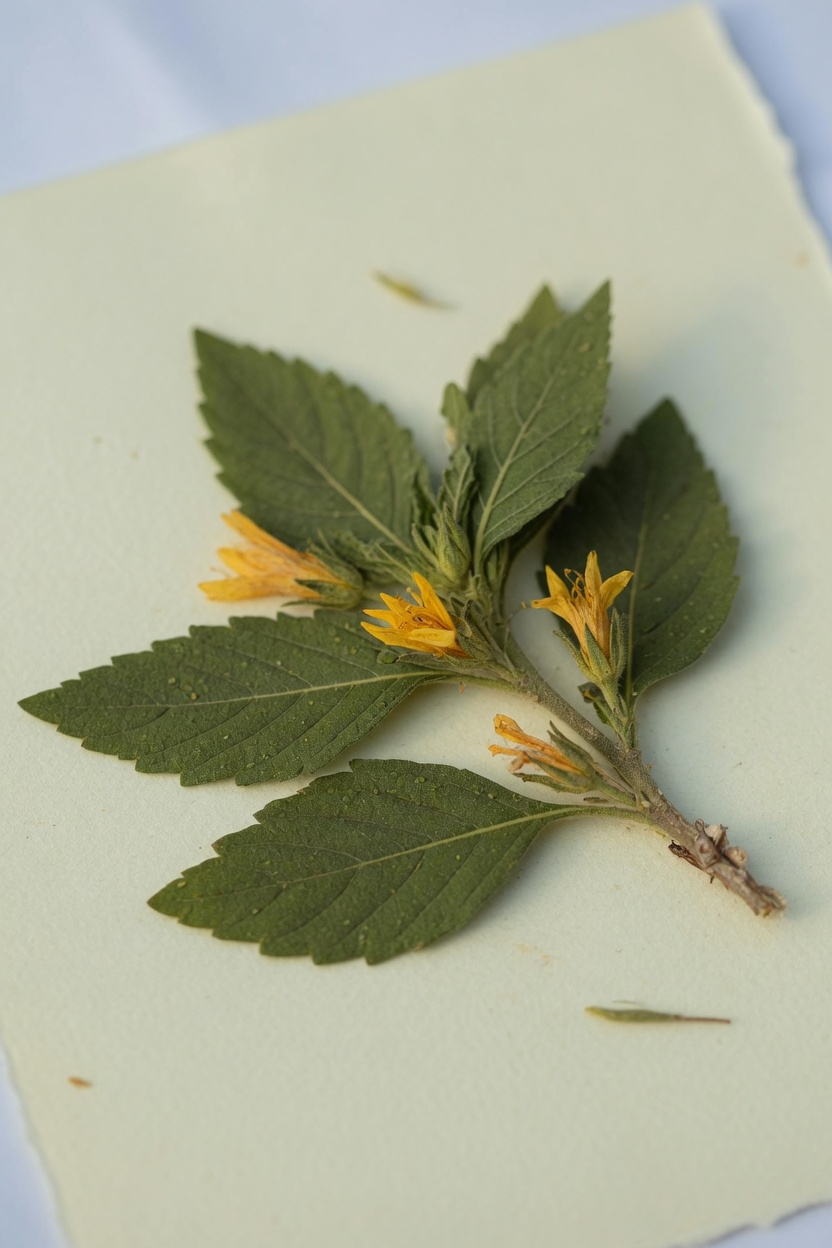
In Jingfu it is one hundred milligrams of Turnera diffusa. In Qifu, fifty, carried over from the acute line. Ease and desire. The leaf, not the root.
A Maya name, then a saint's
Jesuit missionaries in Baja California wrote it down in the seventeenth century. Juan Maria de Salvatierra, 1699: the people of the north made a sweetened extract and drank it as a love potion. The Spanish named it damiana, for St Damian, patron of pharmacists, or so the etymology likes to say. The Maya name is older and more practical. Mis kok, the broom that sweeps illness from the chest. Tea, smoke, a dry-country shrub from Texas to the Caribbean.
Mexico kept it as tea, as liqueur, as a plant you can still find on arid ground. Los Cabos still pours a damiana margarita. Folklore likes to claim it was in the original. Folklore would.
What the catalogues sold
Europe and America bought the reputation in the 1870s. Patent tonics. The US National Formulary listed it from 1888. Pemberton put it in French Wine Coca, then left the leaf out of the non-alcoholic drink that followed. The Latin sometimes printed was Turnera aphrodisiaca, which is a salesman's binomial. We use diffusa.
Passifloraceae now, with passionflower. The leaf is aromatic, slightly bitter, resinous. We keep it for the same reason Jingfu keeps it next to muira puama: a plant with a people and a climate behind it, not a Victorian cure-all.
Why it sits in two formulas
The acute line and the daily one. A small dose, carried through. Jingfu takes a hundred milligrams for the hour. Qifu keeps fifty for the week. Same shrub. Different tempo.
This journal will keep one plate at a time. History first. The formula second. Claims last, and only the ones we can stand behind.
End of plate V.