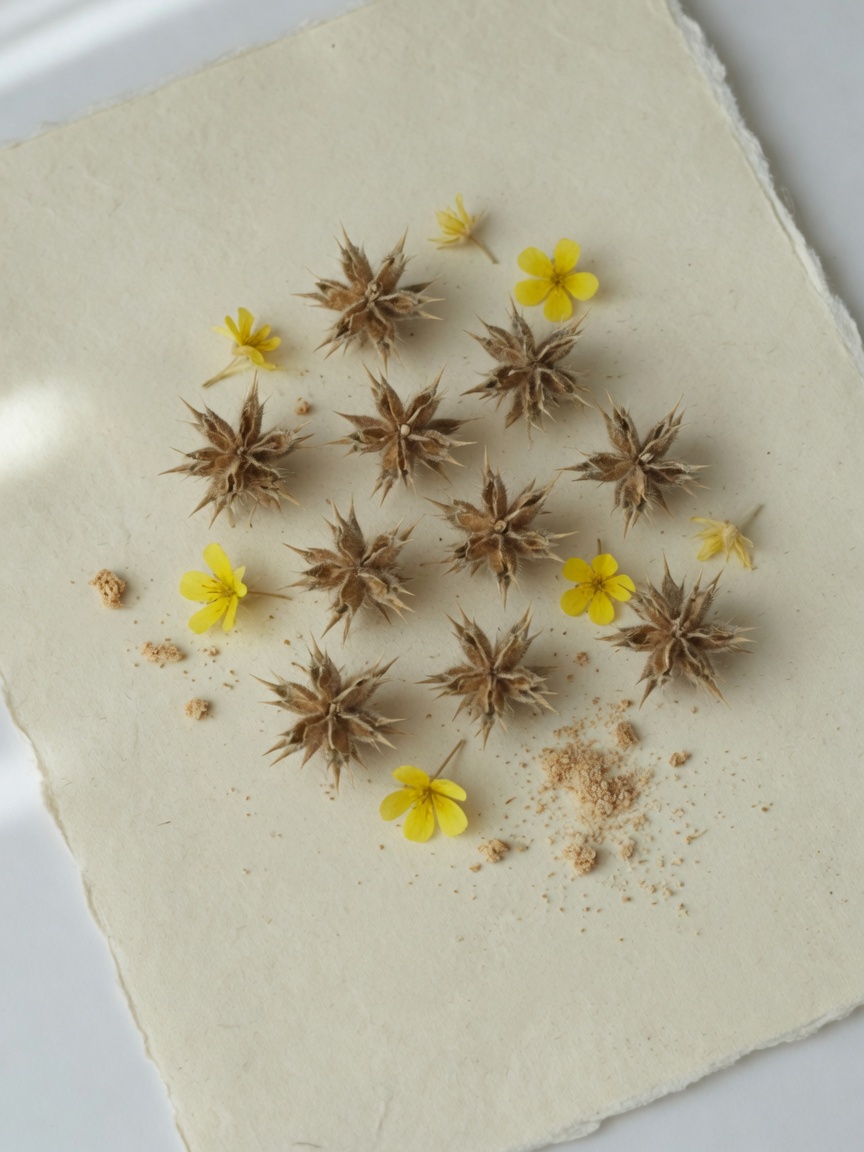
In Qifu it is one hundred milligrams of Tribulus terrestris, listed as a cross-civilisation vitality herb. Gokshura in the Ayurvedic books: go, cow; kshura, hoof or razor. The fruit is the part that travelled. A plant of warm, wasted ground, from the Mediterranean to India to China, wherever the burs could hitch a ride.
A urinary plant, then a gym one
The Charaka Samhita puts gokshura with the herbs that move water: mutravirechaniya, for the urinary tract, for stones, for swelling. The Sushruta Samhita keeps it among the vajikarana plants as well. Powder with milk. A cooling, sweet fruit with spines. Traditional Chinese medicine has a close cousin of the same genus as bai ji li. Dioscorides, writing in Greek in the first century, boiled a caltrop plant in wine and used it as a diuretic. Different languages. The same job, for a long time: water, and vitality.
The gym found it later. Bulgarian extracts, saponins, a testosterone story that the older books did not tell. We do not import that sentence. The fruit earned its place as gokshura first.
A plant that would not stay put
It is a weed wherever it is not a medicine. Australia, America, the edges of fields. The burs are the reason. What looks like a star on a herbarium sheet is a hitch. That is how a local plant becomes a world one.
Zygophyllaceae. The chemistry the papers name is steroidal saponins, including protodioscin. Qifu asks the fruit to sit with maca, ginseng and ginger as a daily practice, not as a spike.
Why it sits in Qifu
The daily vitality. One hundred milligrams. A plant that several medicines kept for the same two reasons: the water in the body, and the private confidence of men. We keep the older use, in the formula that accumulates over weeks.
This journal will keep one plate at a time. History first. The formula second. Claims last, and only the ones we can stand behind.
End of plate VII.