
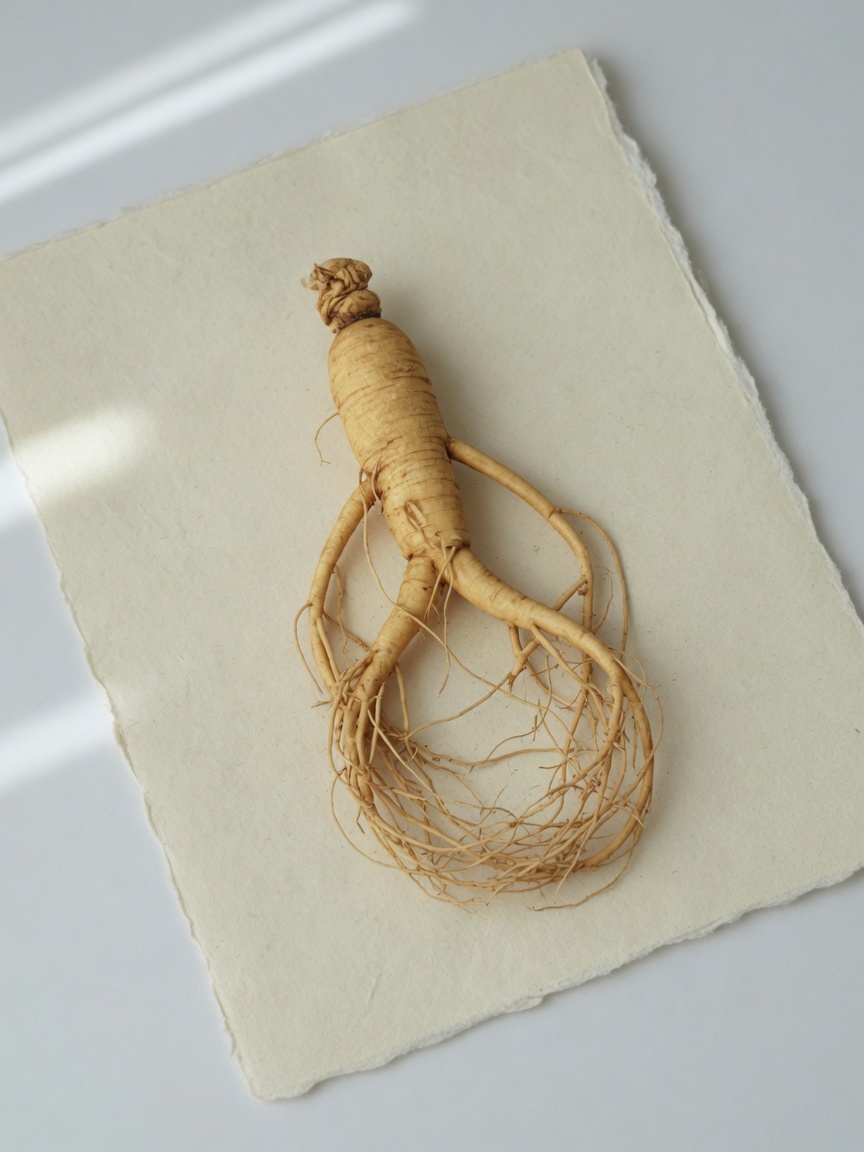
The Chinese call it ren shen: man root. The characters are older than the Linnaean binomial. Carl Meyer later gave it Panax, from the Greek for all-heal, which is a European wish laid over an East Asian fact. In Qifu it is one hundred milligrams of Panax ginseng, the daily vitality, not the acute stack.
Two thousand years of the same sentence
The first written notices sit in the Han dynasty. The Shennong Bencao Jing, compiled around the first century, places ginseng among the superior herbs: a tonic for the long run, not a rescue for the afternoon. Zhang Zhongjing put it into more than twenty prescriptions in the Shanghan Lun. Li Shizhen, writing the Bencao Gangmu in 1596, still called it a superior tonic for the depleted and the convalescent. That is the same sentence, copied by hand, for a very long time.
Wild root was rare. It grew on the slopes of the Korean peninsula and the mountains of Manchuria, between roughly the 33rd and 48th parallels. Kingdoms sent it as tribute. Cultivation is later: Korea and China learning to farm what the forest would no longer give freely. A six-year root is the old standard. Less than that, the body of the root is unfinished. That patience is the point.
What the West received
A stimulant story. What the older books describe is closer to continuity: the capacity to work and to last. We do not import the whole cosmology. We keep the plant that earned it.
Araliaceae, with ivy and the American cousin Panax quinquefolius. The saponins later named ginsenosides are why laboratories keep returning to it. Qifu does not ask the root to be a miracle. It asks it to sit with maca, tribulus, ginger and ashwagandha as a daily practice.
Why it sits in Qifu
Stamina without the spike. The week, not the hour. Jingfu is the Amazonian acute, opened by muira puama and closed by catuaba. This is the East Asian daily. One hundred milligrams, among the plants that accumulate.
This journal will keep one plate at a time. History first. The formula second. Claims last, and only the ones we can stand behind.
End of plate III.